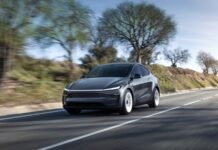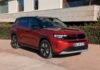

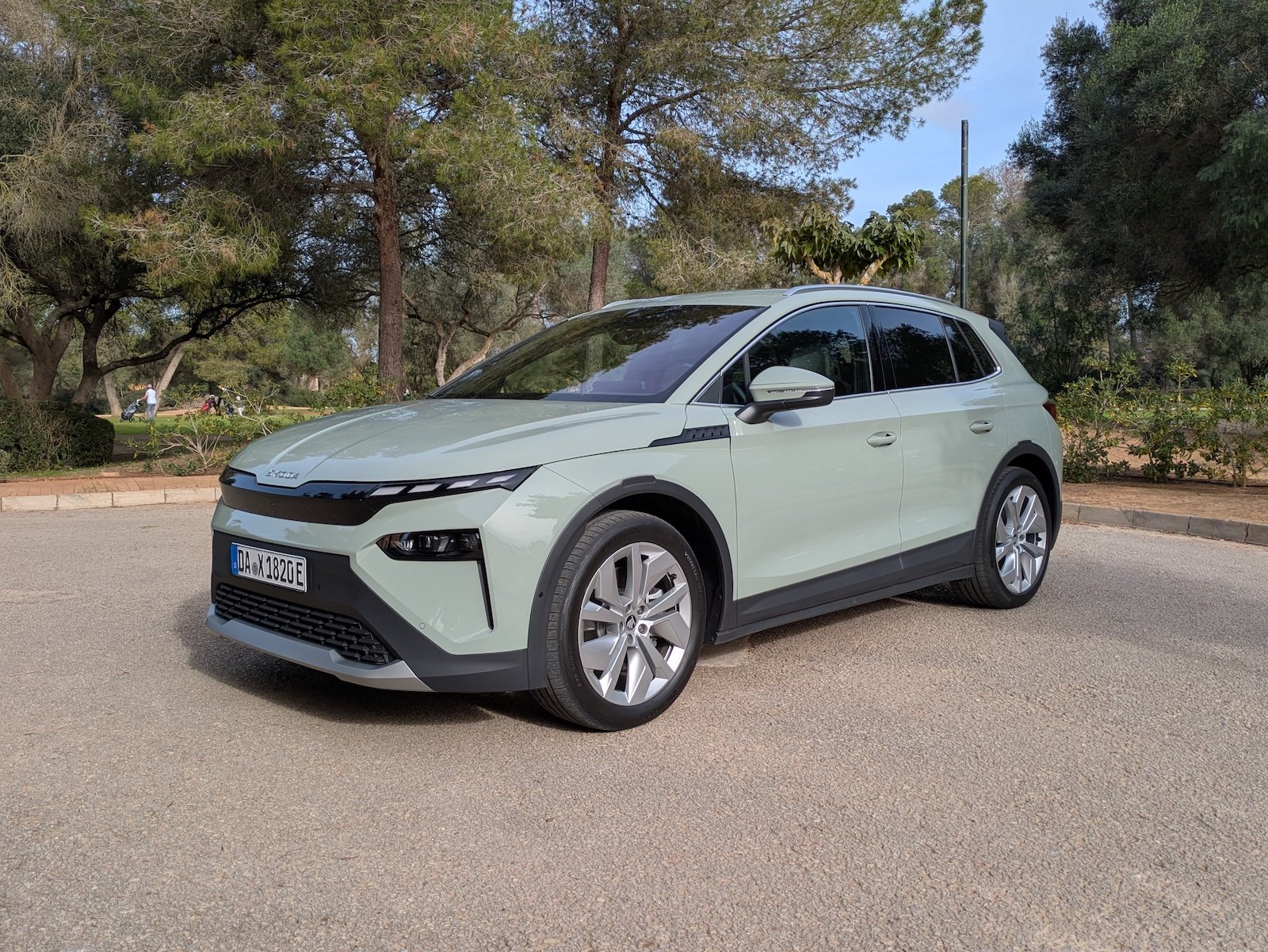
After the relative success of its electric flagship Enyaq, Skoda is now entering the field of quiet compact SUVs to take on the Renault Scenic or Kia EV3, among others. If Elroq can count on the usual strengths of the Czech manufacturer, such as habitability or practicality, it also proudly inaugurates the brand’s new stylistic codes. But what about behind the wheel? Answers on the demanding route, between the expressways and the hilly curves of the island of Mallorca.
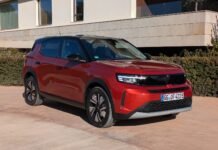
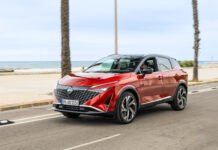
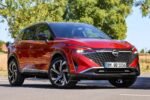
It is therefore a new era, which begins with the deployment of the Škoda electric range, at least aesthetically. The new design called “Modern Solid”, glimpsed by the pencil strokes of the Vision 7S concept 2 years ago, has come to fruition on this Elroq. A simplified design that even abandons the traditional mesh grid and that is enriched with a new highly visual signature. Nothing groundbreaking yet, just go to Hyundai or Citroën to observe similar design solutions. Škoda also ditches the very flamboyant Crystal Face and uses what appears to be the same lighting solution connecting optics as Volkswagens, but here rather hatched than continuous rendering. This is also the end of the Škoda winged arrow logo, the brand is now written in full on the front and back. Black plastic underbody and wheel arch protectors are standard on all trims, and the Elroq is painted Energy Blue as standard. Škoda offers as an option the excellent green Timiano for a reasonable price (700 euros), while the velvet red, also very good, costs 1,100 euros this time. The compact SUV can be equipped with rims from 19 to 21 inches, a choice that can have a significant effect on the behavior on the road, as we will see.
Atmospheres and space
With the Škoda brand, the choice of surface finish very often corresponds to the choice of interior environment. That is why 4 finishes (City, Element, Clever and Plus) are offered as standard with a Loft environment (upholstery made of recycled and quilted fabric, anthracite gray dashboard inserts, etc.). From the Clever appears the atmosphere of the Lodge (€640), which uses the same materials but is characterized by different inserts and especially orange stripes and stitching that give the appearance of a sporty character on board. Finally, only the high Plus finish gives access to the Suite environment (1,800 euros), which allows access to leather upholstery and upholstery, in addition to notably ventilated seats.
Responsive touch screen
A 13-inch central touchscreen is standard on all trims. Inaugurated on the Superb and Kodiaq models, it is particularly responsive, customizable in many ways, leaving the control of the selection of driving modes and especially driving aids to the physical keys. The most annoying ones can be disabled with just two finger actions.

Generous legroom inside
There is plenty of storage space, as is usual with Škoda, and every item on your journey will find an ideal place on board. Note that as standard there is this removable storage box covering what’s left of the rear center tunnel. Rear passengers benefit from a truly generous space with a high and comforting position, without that feeling of legs up, as is sometimes the case with electric cars whose batteries under the floor force an unnatural seating position.
A little smaller trunk volume, but…
At 15cm shorter than the Enyaq, the Elroq pays for its compactness with reduced boot capacity, but don’t panic. At 470 litres, it’s certainly 70 liters less than the generous Scenic, but 10 liters more than the EV3, which is 20cm shorter. The Czech possession nevertheless remains welcoming and benefits from numerous modular solutions. In addition to the small spaces behind the wheel arches (including the cigarette lighter socket), for example, the rear shelf can be used to divide the trunk into 2 horizontal compartments. It is one of the “simply smart” novelties, dear to Škoda, which shows an interest in, for example, limiting the movement of shopping bags and preventing them from tipping over in a too sharp turn.
Storage net for charging cable
Another innovation is a storage net for the charging cable under the same rear shelf, which eliminates the need to empty the trunk if the cable was stored in compartments under the floor. However, it remains to be seen whether this network tends to loosen over time. Accessories unfortunately reserved for the highest version. The bench is also limited to a 60/40 split, not a perfectly flat floor when folded down. Finally, there remains the ski hatch, which is always practical for long items in general.
Rational engines
At the launch of a 100% electric compact SUV, 2 performances are offered: the Elroq 50 with 170 hp for a range of 372 km (battery 52 kWh net) is logically more suitable for urban and suburban use, near charging stations with a range that becomes really fair in difficult conditions (winter, slopes, etc.). Potentially frustrating performance also when entering the highway or in hilly environments, as our test showed. Not so much in pull, as the 310 Nm of torque is plenty, but more in the ability to sustain it.
More convenience to use with the Elroq 85 version
The inconvenience was of course solved by the Elroq 85 with 286 and 585 Nm. With a large battery with a net capacity of 77 kWh, the autonomy increases to 579 km, so there is plenty left with a power unit that is so suitable for all types of roads and travel. This version also benefits from the most powerful fast charger at 175kW compared to 145kW for the rest of the range.
The Elroq 60 version will be available soon
A series that will be completed very soon by the Elroq 60, whose power is adjusted to 204 hp for a battery with a net of 58 kWh and announced for 400 km of autonomy. It’s slightly better than the Elroq 50 on this last point, but should (unavailable during our tests) primarily allow for more versatility in scaling.
Consumption in line with expectations
Regardless of the version chosen, in each case the Elroq has shown surprising consistency in power consumption. Both the Elroq 50 and 85 scored between 17 and 20 kWh/100 km on the same challenging route (highway and mountain bends). This phenomenon is also confirmed by the technical sheet with 15.9 to 16.1 kWh/100 km WLTP for the 50 and 15.3 to 16.4 kWh/100 km for the 85.
Rigid and slightly firm when driving
Škoda has always liked big rims, they certainly add a lot to the design, but they also significantly affect the comfort of damping, especially on urban obstacles. With suspension already slightly biased towards firm by default, it’s better to stay at 19 inches in our eyes. The choice of 20 or 21 inches then justifies the investment in the Drive kit, which adds controlled suspension, a welcome comfort mode as well as a customizable mode across a wide range of damping settings. This package also comes with a paddle wheel that lets you play with 3 levels of braking energy recovery. However, you will have to opt for the Elroq 85 in the High Plus finish to benefit from these technical advantages and even add 980 euros for the option. However, offering a la carte even just a controlled suspension would be a good idea in our opinion, especially since the paddle variant seemed unnecessary to us, since the intelligent mode from regeneration to braking demonstrates real common sense in all circumstances (cuts off in most phases of turning, maximum when driving close to a vehicle or when approaching a roundabout, for example).
Tighter than the Kia EV3
In any case, the Elroq wants to be more rigid in terms of overall road behavior than the EV3, which favors a little more flexibility, but at the cost of more pronounced lean. However, we could perhaps criticize the Czech for the spongy feeling from the brake pedal, quite typical for electric models of the Volkswagen group, which does not help to forget the 1.9 to 2.2 ton weight machine.
Attractive prices
With the first price set at 33,300 euros (50 City), the Elroq has another argument against the Renault Scenic, which demands at least 39,990 euros (Evolution). Its performance is similar (170 hp), but its battery is more powerful and offers 430 km of autonomy. With a price of 35,990 euros, the Kia EV3 puts itself ahead of the Czechs by offering slightly more power and autonomy from the basic level (204 hp for 436 km of autonomy). But Korean is significantly more compact.
Cheaper than the top electric Renault Scénic
To take advantage of the Elroq 85 with controlled suspension, which represents the top model, this time you will have to invest 45,410 euros. Which remains well below the Renault Scenic Techno Iconic variant, which explodes at €52,490, tops out at 220bhp and doesn’t offer controlled suspension. On the other hand, its battery allows a range of 623 km. As for the Kia EV3, it tops out at €45,990 in GT Line trim with 204 hp, but on the other hand, it has a battery with high autonomy comparable to the Elroq 85 and offers a range of between 563 and 605 km. Note that the Elroq range will soon be joined by a dual-engine, 4WD version of the 85X, an offering that the two aforementioned competitors won’t offer.