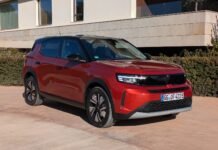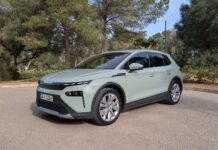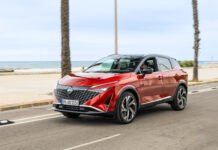

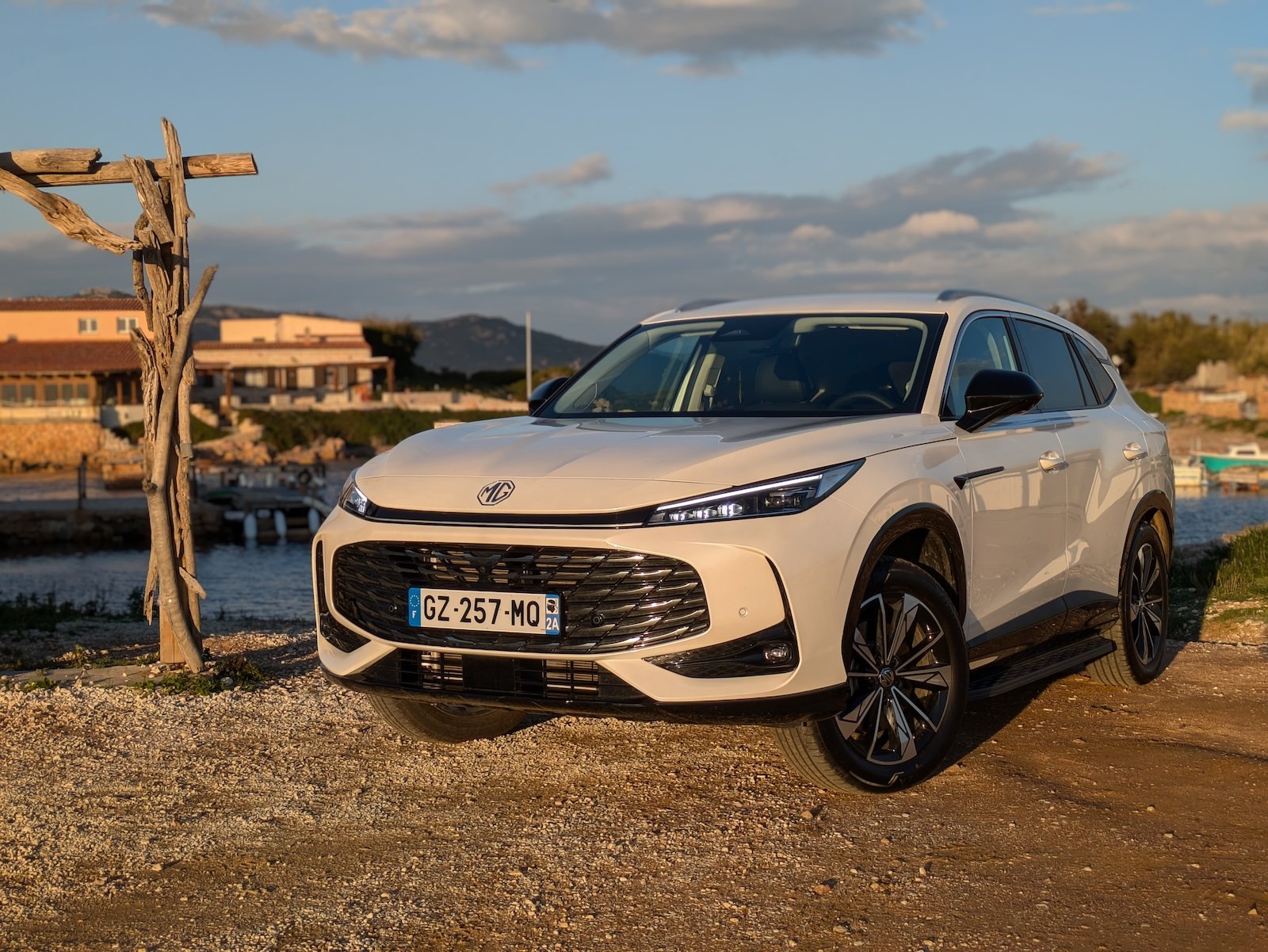
MG has thoroughly redesigned its copy for this second-generation EHS, the Chinese brand’s plug-in hybrid family SUV. It’s more modern and comfortable, it’s also more powerful and can go twice as long on pure electric power. At the cost of some sacrifices.
Choosing an MG model is a bit like choosing a smartphone. Between the iPhone and Huawei or Xiaomi, most of us would jump for the Apple model. But they have become so expensive that choosing a model from another manufacturer that offers almost as much, perhaps does it a little less well, but which above all costs much less, is clearly a reason to hesitate.
It’s not a smartphone (although with interfaces these days…) but The EHS is once again one of those MG models that shakes up the powers that be such as Peugeot 3008, Ford Kuga, Hyundai Tucson or even Volkswagen Tiguan, Toyota RAV4 and more recently BYD Seal U, in the plug-in hybrid family SUV market.
There is nothing to turn
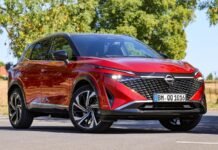
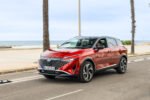
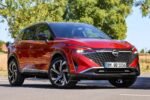
So maybe not his style. As for the front sidevery typical of the brand’s hybrid models, as evidenced by its similarities to the MG3 Hybrid+, there is no lack of aggressionso many other angles have nothing to offer. Of course, the story of tastes specific to everyone, which will be the same when choosing a color, free white or for €650 black, gray, silver, red or blue.
No resizing of the rims is possible on the other hand, fixed at 19 inches, but it seems to be the right compromise between aesthetics and comfort on such a template. Yes, because the EHS has grown: + 6 cm in length, + 1.6 cm in width, + 4.5 cm in height compared to the previous generation, one of the largest SUVs in its class. Its wheelbase (2.76 m) is even the most generous among BYDs.
Plenty of room for passengers
The increasing size which logically it benefits habitability. Boarding the EEC is particularly easy the space offered to both front and rear passengers is considerable. Add a specific task to comfortable seat, very soft as his favorite sofa and that’s clear the Chinese SUV can rack up many kilometers before it starts to feel tired.
A well equipped SUV
The EHS is offered in only 2 finishes, Comfort and Luxury, without optional extras, and is thus generously equipped natively. In addition to a completely redesigned dashboard that clearly improves perceived quality, 2 12.3-inch screens are standardas well as navigation, level 2 autonomous drivingreversing camera, keyless entry and start or i electrically adjustable driver’s seat. The upper trim expands this electric passenger seat adjustment when adding driver memorythe air conditioning becomes dual-zone, the navigation is more connected, the opening of the trunk lid, as well as the folding of the mirrors, becomes electric, the upholstery is decorated with imitation leatherthe camera expands to 360°, in short it lacks practically nothing that the others have, except for a sunroof or a panoramic roof.
Some devices have given way
The big difference will be felt especially on quality and ergonomics of some of these devices. For example, the screens lack the ability to respond to the new generations deployed by some competitors. There are also direct keys for important functions like driving hybridization laws, driving modes, or those driving assistants that have become very intrusive. However, MG announces that it is working on it. And then after a few kilometers, EEC was also betrayed by the quality of assembly which still has to proceed after observing numerous screeching noises coming from the center console.
Trunk volume partially sacrificed
A bit more modular features would also be an advantage. EEC doesn’t really offer than a 60/40 split benchcannot be controlled from the trunk using zips, e.g. without a sliding bench, without separating the trunk floor. However, there is a space at the bottom for the charging cable to prevent it from lying around in the storage area.

The tank also loses capacity
A holder that has also lost some capacity. A consequence of the bias towards the passenger compartment but alsobigger battery in favor of electrical autonomy. WITH 441 litersit returns 22 liters to its predecessor and is among the least generous in a segment dominated at this point by the Ford Kuga and its 575 liters. Still, thanks to the very cubic and clear space the EHS case can fit 4 trunk-type cases on the edges or two + larger + small cabin size.
Electric autonomy doubled
While the previous generation combined a 162bhp 1.5 turbo unit with a 122bhp electric motor for a cumulative output of 258bhp, the new EHS sees a significant advance in its electric machine. Of course, the 1.5 turbo thermal unit lost 19 hp, but the electric motor now develops 184 hp. cumulative power of 272 hp. The battery will also come through from 16.6 kWh (NMC) to 21.4 kWh (LFP) he will allow it, plain and simple double your all-electric range (from 52 km to 100 km WLTP). Well, this big baby that is EHS didn’t lose weight during surgery: Approximately +100 kgit now weighs at least 1,830 kg.
Inspired by Nissan and Honda hybrid technologies
Excess weight, which fortunately will not be felt too much during acceleration thanks to the considerable electrical gain. And then because EHS is inspired by the best of hybrid technologies. Especially those Honda and Nissan, whose qualities are recognized. On board the Chinese, only the electric motor is directly connected to the front wheelssuch as Nissan ePower technology. Thus, in the default electric mode, the EHS prioritizes 100% of its electric autonomy and switches to full hybrid mode after the battery is depleted. However, it is possible to force HEV mode, which will always favor pure electric power until the battery is depleted, giving the driver the opportunity to use the remaining electric power at a time that seems most convenient. In this conservation phase, the heat engine can either drive a generator that recharges the battery in real time, or support an electric motor at speeds above 70 km/h, this time a bit like Honda’s e:HEV technology. MG also benefits 2-speed transmission equivalent to 5th and 6th gear that engages high gears. It doesn’t actually prevent some “noisy overdrive” situations and it’s not possible to force an upshift. But in most cases, this technology surprises with transient silence between its engines and the linearity of its acceleration curve.
Reasonable consumption
Without being a flash, the EHS thus offers enough underfoot to overtake, even on the roads of Corsica, the scene of our test, which did not always leave a lot of space. The road environment showed the same pure electric consumption oscillating between 12 and 16 kWh/100 km AND increased from 0 to 3.3 l/100 km regarding the thermal partonce the battery is dead. The data must be taken with a grain of salt, as it depends on many parameters, especially here that it has driven only 142 km, i.e. mainly on electric power. The same route, dead battery, could theoretically work increase heat consumption to approx. 5.7 l/100 km. Scores that nevertheless indicate good trends in energy consumption.
3h30 for a full charge
Bigger batteries also mean longer time to charge them. Less than the previous EEC because the charger has gone from 3.7 kW to 7 kW, but still necessary now wait 3 hours 30 minutes for full charge. At home, it is certainly not a problem even with a reinforced socket of only 3.2 kW, because charging will take place all night, but when recharging outside your comfort zone, at a public or shared installation, the limitation is strong. Doing it like Mercedes and offering an 11 kW on-board charger would also be relevant here, if only as an option.
Don’t ask too much of him
To return to the analogy from the beginning, pushing the iPhone to its limit is basically not too much of a problem thanks to quality components. The Chinese model leaves more room for uncertainty. EEC is of this type. When you act like a good father, and that’s the most important thing, The Chinese SUV shows off the perfect damping compromiseit is not the most flexible and convenient but Kuze or Sportage is nothing to envy For example. The strength of EHS is its management. Surprisingly honest and insightful for his size. On the other hand, when activating sports mode and raised his voice accordingly, more out of curiosity of course than anything else, The EEC is quickly giving up. Understeer quickly becomes pervasive, the tires writhe in pain, and significant oversteer is likely to cause little paper bags to open in the back very quickly. It is better to stay calm aboard a calm EHS.
Price advantage
There’s one last card left for this second-generation EHS to overcome: its price. Launched on the market between €37,990 (Comfort) and €39,990 (Luxury), it is €5,000 to €16,000 cheaper than its competitorswith the exception of the BYD Seal U (between €37,500 and €44,500). And since this is a plug-in hybrid model, the Chinese electric vehicle import tax will not apply until further notice, so no additional costs can be expected. Finally, add a 7-year or 150,000 km warranty, MG EHS has very attractive economic benefitsboth for individuals and professionals.